

coffee with Babe Martin!
Writing an EP on the precipice of change and moving forward

Some releases don’t just arrive — they drift in, like weather you’ve been sensing for weeks before it finally breaks. Babe Martin’s latest EP, Not A Bee, But A Wasp feels exactly like that. It’s a shimmering world of its own: poetic, majestic and a little bit haunting at the edges.
A lot has changed for Babe Martin (Zoë Larsen Cumming) since the release of her debut project The Versoix EP (2023). That time has settled into her latest EP; a deeply personal documentation of change, from sensing it on the horizon to coming out the other side of it with an entirely new perspective. There’s a tenderness to it but also a sharpened edge — an instinct to protect, to transform, to rise.
I met up with Babe Martin at Blue in Ponsonby one Saturday morning. We stayed there for a very long time, talking about change, quoting musicals and of course, drinking coffee.
BM: My coffee order is a small flat white. Dairy milk. And I usually go for it because it’s one of the cheapest alongside a long black. But I don’t usually drink a long black, unless I’m trying to not be a burden on whoever’s making me a coffee.
KAITLYN: Sometimes if it’s been a real dark week, I’ll get a long black.
BM: Or if someone’s offering me a coffee and they’re gonna make it and it’s a busy time, I’m like, ‘oh, just a long black!’. But I don’t really enjoy it. So it’s just a small dairy flat white!
KAITLYN: I’m usually an oat latte with syrup but today mine is an oat latte with condensed milk, which is pretty cool!
BM: That reminds me of the opening number to In The Heights. Do you know it?
KAITLYN: <scoffs> Do I know it!
BM: “Try my mother’s old recipe.”
BOTH: “One can of condensed milk”
BM: “Paciencia y fe…”
KAITLYN: <laughs> That’s incredible! What a knowledge.
BM: That’s what I thought of when the waitress kindly offered you some condensed milk.
I first met Zoë aka Babe Martin when I moved up to Auckland at the end of 2023, but I don’t think we actually ever talked about both of our relationships with theatre until about six months into knowing each other. Now, she is one of my favourite people to see a show with.
KAITLYN: How did performance come into your life?
BM: My mum is a really lovely singer. She was always singing from the get go. And then I think my earliest memories of music are being five in Wellington, and I won my first and only trophy singing Castle on a Cloud.
KAITLYN: Of course you did!
BM: My singing teacher was a very emotional woman and she changed the ending of Puff the Magic Dragon because the original ending made her too sad. Instead of Puff going away forever, Puff reunites with Little Jackie Paper and they become friends forever. So that’s my memory of music. And then another early memory, because I guess primarily I sing and play piano, was when we moved to Australia, the house we were renting had a piano that was so crap that the landlord didn’t bother taking it with them. So I would just like bang around on that, and then that’s how I started playing piano.
KAITLYN: How were you vocally trained? Because you give classically trained.
BM: Oh, thank you so much! I sang in choirs growing up. In fact, I think my mum was asking a friend of hers, because my mum also sings in choirs, like, ‘oh, Zoë loves to sing, she’s got a lovely voice, what should I do? Should I get her lessons?’ And her friend was like, ‘the best thing you can do is put her in a good choir, that teaches you how to harmonise and listen and be part of a team’. So yeah, choir is the training I have.
KAITLYN: Did they have a ‘Big Sing’ equivalent in Australia?
BM: Well, there was, but we never competed in it. I had this really staunch choir director who was really scary. Her name was literally Alpha. And... I remember approaching her one time asking if we could perform, but she had this mentality, which I do actually carry with me where she was like, ‘music shouldn’t be a competition. I don’t want you guys to be practising and working really hard in a competitive way. The applause should be your prize. The audience reception should be your prize. You shouldn’t be doing it for like a monetary reason’.
KAITLYN: Music and performing… it’s a tough gig already. So when it’s competitive like that, it’s even tougher. You’ve just got to do it because you really like it. It’s quite cool to have that instilled a young age.
BM: Yeah, I’m not really interested in any singing competitions or anything now.
KAITLYN: Well you don’t need to be, you won the trophy.
BM: I’ve won!
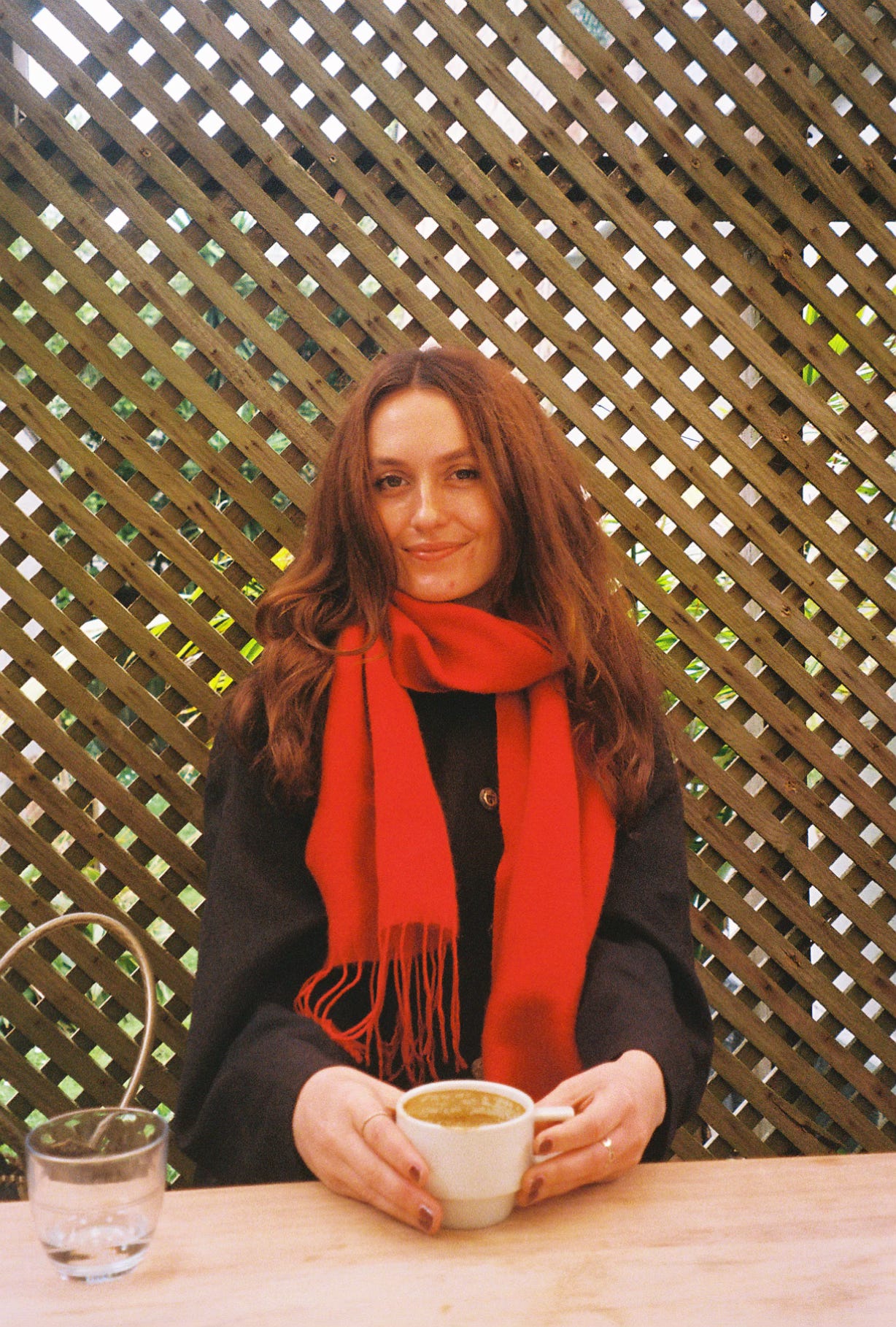
(Babe Martin at Blue in Ponsonby / Photo: Kaitlyn Ratcliff)
KAITLYN: With The Versoix EP, there is a gentle simplicity and a real delicacy to it. This new EP, it’s still delicate, but it feels heavier. It’s like Babe Martin gone punk, but not really. There’s more instrumentation, electric guitars, there’s slides. There’s an evolvement. Looking back at yourself from Versoix to Not A Bee, But A Wasp, what was the change for you in between writing one and the other that influenced the music?
BM: Versoix I wrote in 2022 and I was in a very different place. For one, it was the lockdown, but I don’t think that played too much of a part in it. But comparatively to how long I’ve been in New Zealand now, New Zealand still felt quite new to me. I felt a lot of nostalgia for other phases of my life in a way that I don’t necessarily now. I think it’s kind of like an early 20s thing that you are aware of the passage of time all of a sudden in a way that you hadn’t been before. And so I was like really looking back at the time I spent in Switzerland as a teenager, the process of moving to New Zealand, the uncomfortable feeling of having throughout my life, my family always scattered around in different places and never being with everyone that you love, all at one point, like always missing someone. It was a lot about family and place and space. And where you are in relation to other people and other points in your life. Not A Bee, But A Wasp… to be totally frank, when I was writing most of these songs I was in a relationship that wasn’t working, and wasn’t meant to be, but nothing had happened. Nothing bad enough had happened to end it, so you’re just kind of in that weird limbo where you’re like... this should probably end. But I don’t know how to do that and I’m not even admitting to myself that feeling. So that’s where the songs were coming from. That sort of precipice of change and where you know there’s a decision that’s got to be made, but it hasn’t yet. And then there are other ones like Only Good and Summer Fruit. The two last songs on the album. They were written after that decision had been made, in the sort of new phase, the exciting part of it and then the reflective part of it. But I would not describe it as a breakup album. It’s definitely not about a relationship. But that is the background that was informing it. And all of the songs on the EP are in chronological order just like how they were written. Which wasn’t intentional, that’s just the way that they sounded right.
KAITLYN: In that case, let’s go through these songs in chronological order. ‘Calendar’ starts the record off — how was the world of this track built and navigated?
BM: Calendar is kind of a link, I think, between Versoix and Not A Bee, But A Wasp because it is about that feeling that’s explored a lot on Versoix, where you’re really missing someone and you’re counting down the days to see them again. It was written when I was in the UK, visiting my family, and it’s about missing the people back at home, but also feeling that freedom of being away from New Zealand. Which, because like, I love New Zealand, I love Auckland, but you can get lost in the soup sometimes. And then when you’re out of it, it’s just like, it’s nice to have some perspective.
KAITLYN: ‘Sundog’ is the second track on the EP and admittedly before I came here today I was looking up what Sundog’s look like… they’re quite stunning! And very rare…
BM: I think I’ve seen two in my life.
KAITLYN: Wow, that’s amazing. I’ve never seen one!
BM: Oh you’ve gotta be looking at the sun more <laughs>. Sundog definitely explores that tension I was talking about with Calendar where you know that change is on the way. It’s inevitable. But it’s not here yet, and you don’t want to force it. You’re just sort of waiting and you don’t know when it’s gonna come. So yeah, it’s exploring the calm before the storm and it’s quiet, but a bit uncomfortable. I think that has just naturally happened with the sound of it as well. It’s quite a beautiful song instrumentally, but it’s a bit eerie.
KAITLYN: It’s almost unnerving in a way… you can feel the discomfort with change on the horizon and waiting for that to pass through. The next song, ‘April In The City’, tells the tale of literally what April is like in Auckland, but it also sort of hides a bit of what is going on in the background emotionally. At the end, everything’s just like simmering to the top of the pot.
BM: Absolutely. First of all, I love April. It’s my favourite month of the year. I love it so much. I love all of the poems about April. I like songs that are about April, so I wanted to have my own song about that month. And then it was April. I was living in an apartment in central Auckland which I really loved. It had these beautiful brick walls and wooden floors. It was really cool. And I was just kind of writing about what was up, what was happening. Again, like Calendar and Sundog, there’s that sort of like, life is all good, you’re going through your routine, everything’s fine, but under it all there’s just this undercurrent of like, I don’t think this is it for me. I think this will inevitably change at some point and you don’t think about it all the time, but then when you’re quiet and you’re still and you’re by yourself, that’s the thing that kind of bubbles to surface. You’re like... Hmm. Something’s not quite right.
KAITLYN: What is your least favourite month?
BM: My least favourite one… Oh, probably New Zealand August. August is such a drag in New Zealand. The film festival’s over. And it sucks. It’s cold. everyone’s really sad. But then I feel like August in the Northern Hemisphere is so... Oh, it’s so romantic. It’s the end of summer. Do you know that, Simon and Garfunkel song, April Come She Will?
KAITLYN: Yes!
BM: That’s like why I love the month of April. I just love that song.
KAITLYN: I love that ‘April In The City’ gets more intense musically as it gets more open lyrically. Which leads perfectly into ‘Only Good’. That one is pretty straight up. The EP as a whole is built with these beautiful poetic phrases but this song is very much like, here’s everything bare on the table.
BM: <laughs> Only Good is so frank. It’s so funny. And there aren’t that many lyrics. When I was typing them out for bandcamp, I was like, oh my god, it’s not very long.
KAITLYN: “You don’t know me so you don’t owe me nothing” is such a good sentiment to remember at the start of a relationship. It’s like, oh, you don’t know this person. Expectations are low. I don’t know you, you don’t know me. It’s fun!
BM: I feel like Only Good is quite refreshing after the other three because with the other three, it’s like kind of like you know how you’re feeling but don’t don’t know if you can say it because the stakes are kind of high. Like, you know, you put in all this effort in this relationship, I guess. So it’s harder to say how you feel. Not if it’s a healthy relationship, I might add. But, Only Good, that’s about the very very start of something. where there are no stakes. It’s just fun. And you can kind of say what you want because what’s the worst that can happen? They don’t agree and it doesn’t work out, and that’s okay because you didn’t know them very well.
KAITLYN: There’s no pressure at that point.
BM: There’s no pressure, but then there’s no security either. So that’s the other side of the coin where you’re like, well, this is cool, but I don’t really know what’s going on. And we’ll have to address that at some point, but not today. We’re gonna sing about it first. <laughs>
KAITLYN: You put out a music video with Only Good and our dear mutual friend Ali Burns directed it. How did you both conceptualise it?
BM: I approached Ali because we’d worked on some projects together before. I had acted in her film, The Magic Orange. So I just love her style and she’s really creative and has a very interesting mind. And I knew I wanted to expand on the beekeeper motif that was introduced in Sundog. So I just approached her and was like, I really want to make a music video for the song, play with the beekeeper idea, probably like in a domestic setting. What do you think? And she was really keen and on board and we just went from there. She has such a beautiful, creative mind. What I love about Ali as well is she is so thoughtful and she’s so calm. With that, she was so organised, she knew everything she wanted to do, and it was like, we didn’t faff around, but there was no stress, no pressure on that set either, which is how I like to do things, especially with music. It’s meant to be fun. It doesn’t matter if things don’t go to plan. Who cares? So I like being prepared enough that you know what you’re going to do. It’s like, what is meant to be will be.
KAITLYN: That’s a great segue into ‘Summer Fruit’.
BM: This is maybe my favourite one.
KAITLYN: Woah!
BM: It’s also Nava’s favourite one.
Navakatoa Tekela-Pule (LEAO, Erny Belle, Noa Records) mixed Not A Bee, But A Wasp, and shares production credits on the EP with Zoë and Maude Minnie Morris, who also plays bass on the record. The EP also features Zoë’s band: Harry Thompson-Cook on guitar, Fen Ikner (LIPS) on drums and Amy Boroevich (HINA) on violin/viola. Mastering the EP was Amelia Berry (Amamelia). Zoë has a lot of love and time for her team, which is clearly packed full of some of New Zealand’s finest musicians.
BM: Summer Fruit was the last song I wrote for the EP. I went through a huge period of change and really hard shit, and at the end of it I had a lot of perspective on what matters most to me, which is the people that I love. It was like a superpower where I just kind of felt quite invincible to all the petty shit, all the drama or like, oh, someone said X-Y-Z about someone else and oh, that person was kind of rude to me at that party. I just didn’t care. And then at the same time, I was like going into this new relationship and which was really lovely and is still really lovely. But yeah, I just kind of, I had this huge change of perspective, which I hadn’t had before. It has made me a much more chill person. It was that feeling of like going through something so huge and terrible, coming out the other side and just being like, everything’s okay. I can literally handle anything. And it’s all gonna be fine.
There is something beautifully symbolic in the title Not A Bee, But A Wasp. A bee dies after it stings, but a wasp survives. It sharpens itself, returns to the air, and carries on. This new chapter for Babe Martin seems built around that difference — an acceptance that so much lies outside our control, and yet there’s a strange comfort in that. Because what we can hold onto, what is fully ours, is the choice to rise again. By the end of the EP, it feels as though Babe Martin has become the wasp.
KAITLYN: Thinking about the EP as a whole, what do you want people to take away from it after listening?
BM: I think lots of people write, and myself included, to feel like understood. I think it’s kind of like sharing a part of yourself. It’s like, this is me. But I don’t know if I necessarily want... I’m not writing it to be like, please, see me. I don’t have anything that I want people to take away from it.
KAITLYN: Just for people to take it away.
BM: Yes! Just take it away! Enjoy it. Which is the best kind of thing really. Book me for a show! <laughs> I’m in it for the money.
BOTH: <laugh>
KAITLYN: You’re in it for a trophy <laughs>.
BM: <laughs> I want another trophy.
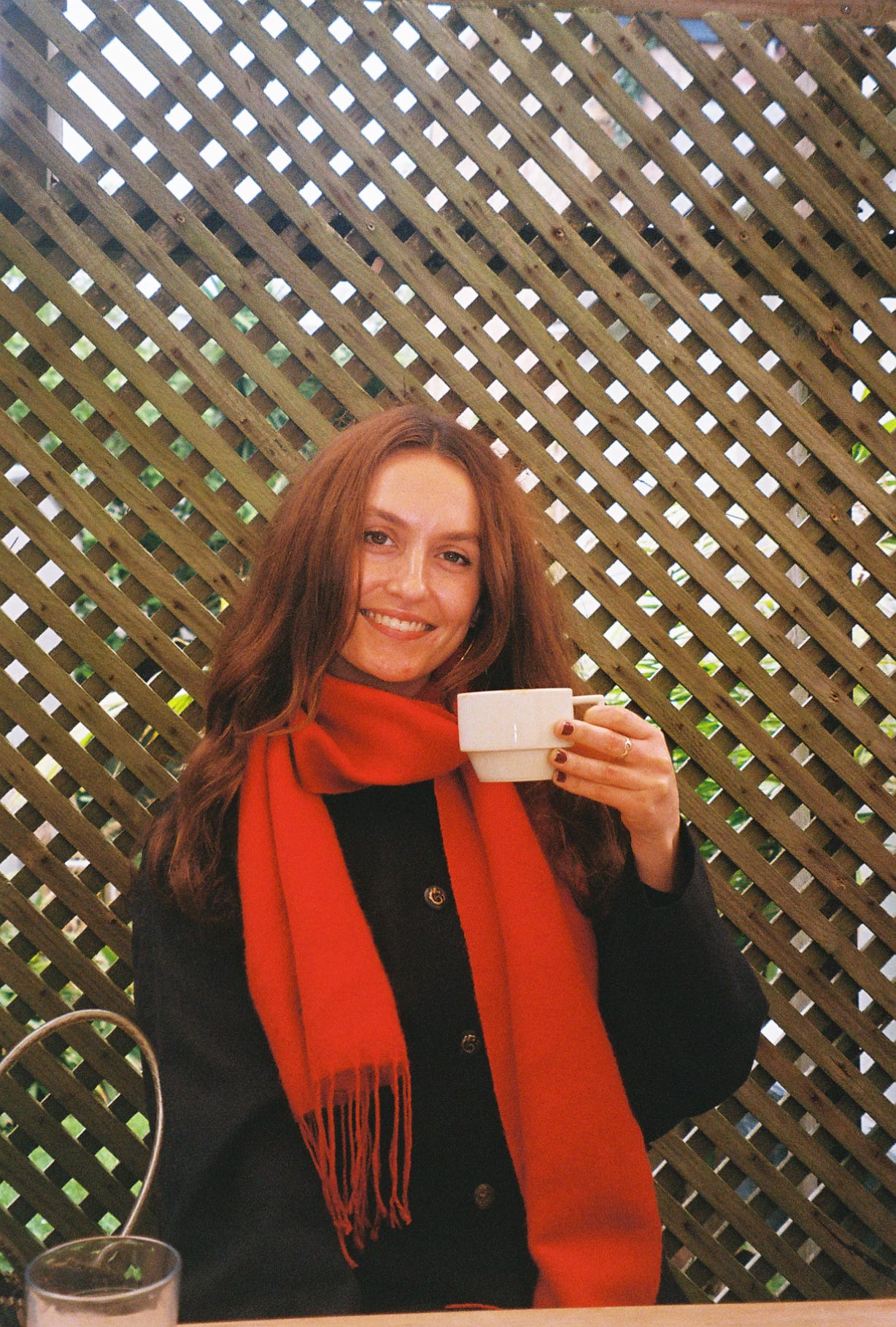
(Babe Martin at Blue in Ponsonby / Photo: Kaitlyn Ratcliff)
Thanks for grabbing coffee with me Zoë, it was an honour x
‘Not A Bee, But A Wasp’, the sophomore EP from Tāmaki Makaurau based artist Babe Martin is available now wherever you find good music. You can catch her and her band performing the EP live this Thursday 20 November at the Auckland Unitarian Church. Tickets are available from Under the Radar.